woensdag 14 oktober 2015


Is flavour science a positive science, in the 'Wittgensteinean' sense ? 

His Tractatus Logico-Philosophicus consists of numbered propositions in seven sets.The seventh set contains only one proposition, the famous "What we cannot speak about we must pass over in silence." One of the most misunderstood and misused phrases in literature and daily life.


The major theme of the Tractatus as a whole is that fact that propositions merely express facts about the world. The propositions in themselves are entirely devoid of any value. The facts are just the facts. Everything else, everything about which we care, everything that might render the world meaningful, must reside elsewhere because it can not be expressed in logical propositions. 

A properly logical language, and only this, Wittgenstein held, deals only with what is true. Aesthetic judgments about what is beautiful and ethical judgments about what is good cannot even be expressed within the logical language, since they transcend what can be pictured in thought. They aren't facts. 

The book concludes with the lone statement: "Whereof one cannot speak, thereof one must be silent."  This is a powerful message indeed, for it renders literally unspeakable so much of human life. 

That it can be not applied to flavour science is obvious, but nevertheless people try to summarize their sensorial experiences in words. They have a value in the sense that it can help flavorists to focus on the same topic and to have a common language between flavorists and customers. The terms can however never express the total multisensorial experience of fragrance or flavor. 

The following article is a good example of what I mean :


(sorry for the advertisement film in the text of the article)

maandag 12 oktober 2015


Source : www.volatileanalysis.com/blog/what-is-off-odor/


What is Off-Odor?

FunnyOdor_Post-Featured-Image 

The true answer is you’ll know it when you smell it!  Doesn’t have to stink like dead fish or 2 week old ground beef left in the refrigerator, although those certainly are obnoxious.  

Off-odor can be a nice fresh floral smell, like that of a rose, only the rose aroma originates from a batch of freshly roasted pecans.  The rose aroma doesn’t belong there.  It detracts from the richness of deep, warm, roasted pecan aroma.

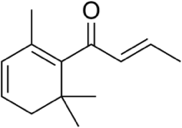
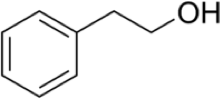
Many off-odor projects we tackle at Volatile Analysis involve issues akin to that of rose-pecan.  Aroma chemistry tells us one very common fragrant molecule that has an aroma similar to rose is 2-phenylethanol.  Others closely associated with rose aroma include cis rose oxide and beta damascenone.

molecule3molecule1                                                                  molecule2                 
Chemical structures of molecules with rose aroma including 2-phenylethanol, cis rose oxide, also known as (2S,4R)-2-(2-Methyl-1-propenyl)-4-methyltetrahydropyran, and beta-damascenone, also known as (E)-1-(2,6,6-Trimethyl-1-cyclohexa-1,3-dienyl)but-2-en-1-one.

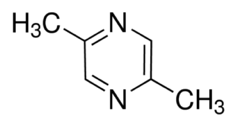
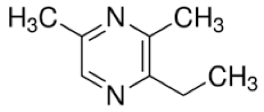
The chemical class most responsible for roasted pecan aroma include pyrazines that develop during the roasting process.  This class of chemicals is also found in roasted coffee, seared meats, chocolate, and many other common products (including tobacco smoke).  They are produced via the Maillard reaction and require the presence of a reducing sugar and an alpha amino acid.  Pyrazines responsible for nutty aroma include the simple ones below, as well as one known as “nutty pyrazine” with the long chemical name (7R)-7-methyl-6,7-dihydro-5H-cyclopental[b]pyrazine.

molecule4                       molecule5
Simple chemical structures associated with roasted, nutty aroma: 2,5-dimethylpyrazine, 3-ethyl-2,6-dimethylpyrazine.

If we were tasked with determining why roasted pecans had a floral, rose off-odor, we would know it likely was due to one of those structures listed above, or something of similar chemical structure.

To positively identify the off-odor we would employ an analytical technique called gas chromatography-mass spectrometry/ olfactometry (GC-MS/O).  We would be able to rapidly identify the major (and minor) aroma active chemicals responsible for the overall roasted pecan aroma, including that contributing a rose off-odor!